
Seabiscuit
Season 15 Episode 11 | 52m 55sVideo has Audio Description
An over-worked horse and a broken-down jockey capture the nation's imagination.
Seabiscuit was dung-colored and boxy, with stumpy legs that wouldn't completely straighten, a straggly tail and an ungainly gait, but though he didn't look the part, he was one of the most remarkable thoroughbred racehorses in history.
See all videos with Audio DescriptionADProblems playing video? | Closed Captioning Feedback
Problems playing video? | Closed Captioning Feedback
Corporate sponsorship for American Experience is provided by Liberty Mutual Insurance and Carlisle Companies. Major funding by the Alfred P. Sloan Foundation.
Support provided by:


Seabiscuit
Season 15 Episode 11 | 52m 55sVideo has Audio Description
Seabiscuit was dung-colored and boxy, with stumpy legs that wouldn't completely straighten, a straggly tail and an ungainly gait, but though he didn't look the part, he was one of the most remarkable thoroughbred racehorses in history.
See all videos with Audio DescriptionADProblems playing video? | Closed Captioning Feedback
How to Watch American Experience
American Experience is available to stream on pbs.org and the free PBS App, available on iPhone, Apple TV, Android TV, Android smartphones, Amazon Fire TV, Amazon Fire Tablet, Roku, Samsung Smart TV, LG TV, and Vizio.
Buy Now
When is a photo an act of resistance?
For families that just decades earlier were torn apart by chattel slavery, being photographed together was proof of their resilience.Providing Support for PBS.org
Learn Moreabout PBS online sponsorshipANNOUNCER: Tonight... GELO HALL: This horse had to come from the bottom of the heap.
GENE SMITH: He looked like he ought to be drawing a cart with ice behind it.
LAURA HILLENBRAND: There is something quintessentially American about everyone in this story.
The ability to triumph over hardship.
CLEM MCCARTHY: Seabiscuit is the winner!
ANNOUNCER: "Seabiscuit," on "American Experience."
(crowd cheering) NARRATOR: On New Year's Eve 1938, columnist Walter Winchell published his annual list of the top ten newsmakers.
Nine men were named, including Franklin Delano Roosevelt, Neville Chamberlain, and Adolf Hitler.
The tenth spot went to a horse.
(hooves galloping) ♪ ♪ GELO HALL: He was a hero.
You know, this horse had to come from the bottom of the heap to the top.
CLEM MCCARTHY: They're head and head.
It's horse against horse.
Seabiscuit leads by a length... HALL: He fought his way up the ladder, and I think this was the thing that people liked about him.
And I think that's the way America likes-- sometime-- to crown their champions.
ANNOUNCER: Ladies and gentlemen, NBC has turned over its nationwide facilities.
They pay tribute to Seabiscuit, the wonder horse.
GENE SMITH: Maybe the fact that he had the hard-scrabble beginning; maybe the fact that he wasn't good-looking-- he was blocky, he was coarse, crude-looking; maybe the fact that he had a kind of busted-down jockey; somehow, it all came together to create a star.
LAURA HILLENBRAND: He came along in the worst years of the Depression.
Americans were down and out.
They were poor, they were losing their jobs and their houses, and they, they wanted a hero that came from the wrong side of the tracks, that was beat up like they were.
And for a brief moment in America, a little brown racehorse wasn't just a little brown racehorse, he was the proxy for a nation.
Sure he's small in the body, but big in the heart.
What do they call him?
Seabiscuit.
♪ ♪ RADIO ANNOUNCER: Out of the musical hall of fame "The Big Ten," a tune that has captured the fancy of the nation.
BING CROSBY: ♪ Now, I ain't got nobody ♪ (horse neighs) NARRATOR: On a mild summer afternoon in 1936, a three-year-old thoroughbred named Seabiscuit was saddled up for a cheap stakes race at Boston's Suffolk Downs.
The purse was a paltry $700.
CROSBY: ♪ Won't somebody take a chance with me?
♪ NARRATOR: The colt was a direct descendant of the legendary Man o' War-- but you'd never have known it to look at him.
Dung-colored, stocky, and low-slung, with knobby, asymmetrical knees that didn't quite straighten all the way, he was a masterpiece of faulty construction.
(hooves galloping, crowd murmuring) He'd been raced an astonishing 35 times as a two-year-old-- more than triple the average for a horse his age-- and he'd lost nearly every time.
(song ends) But now, as he ambled past the grandstand, he caught the eye of one of the spectators, a veteran horse trainer named Tom Smith.
HILLENBRAND: Smith nodded at the horse and the horse nodded back at him, and later said it was kind of as if the horse was paying him an honor to notice him.
And the pony boy tugged the horse on his way, and Smith said, "I'll see you again."
♪ ♪ NARRATOR: Despite his appalling record, Smith saw something special in the colt.
"He had a look," the trainer said later, "of true confidence."
Smith's employer, an ex-bicycle repairman turned automotive magnate named Charles Howard, saw it, too.
A few weeks later, he bought Seabiscuit for the bargain-basement price of $8,000 and sent him west with Smith to the Detroit fairgrounds racetrack to train.
(horse neighing) The stable hands in the Howard barn were skeptical.
None of them had ever seen such an equine catastrophe.
The colt paced in his stall, broke into a lather at the sight of a saddle, and lunged at anyone who dared to go near him.
When he ran, his left foreleg jabbed out wildly, as if he were swatting flies.
Horsemen called it "an eggbeater gait," and most considered it a sign of lameness.
But Tom Smith knew what he was doing.
A man so laconic that a reporter once suspected he'd removed his tongue, Smith had little patience for people or their opinions; horses he understood.
FARRELL JONES: I think that all he ever thought about was a horse.
"Silent Tom" is what they called him.
(imitates horse whickering) He'd do that.
(imitates horse blowing) But I don't know that he, he was aware he'd do it; I don't think, but he, I... No, he'd do that, I'd see him... (imitates horse whickering) ...do that quite a bit.
I mean, he was a great horse trainer.
Now, he was a dedicated guy to what he did, and that was it.
NARRATOR: Smith made a careful study of Seabiscuit, then devised a regimen targeted to the colt's specific problems.
For nerves, an assortment of soothing animal companions: a spotted dog with enormous platterlike ears and an amiable yellow cow pony named Pumpkin.
For leg soreness, daily applications of a homemade liniment.
And finally, a diet consisting of a high-quality, calcium-rich strain of timothy hay, which had to be special-ordered from Northern California.
The stable hands were instructed to give Seabiscuit maximum latitude and, most importantly, to never, ever disturb him while he was sleeping.
HILLENBRAND: Most horses can only sleep on the ground for about five minutes at a time because their bodies are so enormous and they're configured in such a way that breathing becomes difficult.
Seabiscuit was the exception.
He would sleep and sleep and sleep.
(horse whickers) NARRATOR: Gradually, Seabiscuit relaxed and rounded into form, but he still didn't show much interest in running.
Smith wondered where he would ever find a jockey sensitive enough to handle him.
As it happened, the jockey found him.
♪ ♪ His name was John Pollard, but thanks to a shock of flame-colored hair, most people called him "Red."
♪ ♪ NORAH CHRISTIANSON: He was very, very charming.
He had kind of a leprechaun-ish face.
He, he was not short.
He was, uh, about five-six, and, uh, that is tall for a jockey.
Uh, very thin, sinewy, um, like a dancer.
♪ ♪ He quoted Shakespeare at great length, and, uh, he carried around, uh, several books of, uh, poems everywhere he went.
I think he was capable of being a great many things.
♪ ♪ My father just went to the fourth grade, and a teacher told him that he wouldn't amount to anything, and I think that that, uh, rode him all his life.
NARRATOR: One of seven children born to a bankrupt brick manufacturer, Pollard had left home at 15 in the care of a guardian, who then promptly abandoned him at a makeshift racecourse in Butte, Montana.
He'd spent the next dozen years kicking around the country's lowliest tracks, talking his way onto as many mounts as he could and working as a prizefighter to make ends meet.
Pollard drifted onto the Detroit fairgrounds one afternoon in July 1936, with 27 cents and a few sugar cubes in one pocket and, in the other, a half-pint of a cheap brandy he called "bow-wow wine."
HILLENBRAND: Red Pollard had been at a racetrack where his last mount had simply refused to finish his race.
He had a six percent winning average, which is horrendous for a jockey.
He would have taken any mount that day, and he went to every single barn on the track.
No one would hire him.
And he went into the last barn, and Tom Smith gestures to the stall, says, "I've got a horse here."
CHRISTIANSON: When they first met, he talked to the horse and the horse responded positively-- which this horse did not usually do-- and Tom Smith, being a very astute judge of man and beast, that he, he knew there was something there, some affinity.
A connection.
(horse nickers softly) HILLENBRAND: Pollard put his hand in his pocket, pulled out a sugar cube, and held it out to the horse.
And the black muzzle touched the jockey's shoulder.
(horse nickers) It was the first affectionate thing Seabiscuit had done to anybody, and Tom Smith thought, "This is my man."
♪ ♪ (horse snuffles) Red Pollard had spent his career at bad racetracks on bad horses-- the worst animals on the circuit.
He understood troubled horses.
♪ ♪ He was not a guy you would put on a great racehorse, but this is, this is the one he fit.
So, he wasn't a great jockey, but the moments he was on Seabiscuit, he was great.
NARRATOR: Separately, they were nothing more than a failing jockey and a broken-down horse.
Together, they would become hard-luck heroes for a troubled nation.
MAN (on recording): Come on, get out there.
CROSBY: ♪ I'm no millionaire, but I'm not the type to care ♪ ♪ 'Cause I've got a pocket full of dreams ♪ ♪ It's my universe, even with my empty purse ♪ ♪ 'Cause I've got a pocket full of dreams ♪ NARRATOR: In the lean days of the Depression, thoroughbred racing was fast becoming America's most popular sport.
Bans on wagering, passed at the turn of the century, had mostly been lifted by the late 1920s, and revenue-hungry states across the country had rushed to re-legalize racing.
MAN: English Manor to place, six-to-one-- to win.
MAN 2: Lucky George to win at six-to-one.
SMITH: The opportunities for gambling in the 1930s were very limited.
There were no state lotteries.
Football was a very minor sport.
If you wanted to bet on a prize fight, you had to go find a bookie or something.
There were casinos in Nevada, but how many people go to Nevada?
Hence, the only place you could really bet was at a racetrack.
(starting bell rings) (spectators cheering) JACK WHITAKER: I expect it was a release-- the dream of making a lot of money, which was in everybody's head in those days.
But I would think it was an escape for them, like the movies were, radio was-- escape, 'cause it was a, kind of brutal times.
People went to the races, uh, six days a week in those days-- 20,000, 40,000 people.
(song continues) SINGERS: ♪ Got me a pocket full of beautiful dreams ♪ (song ends) NARRATOR: By the fall of 1936, Tom Smith still didn't know if his gamble on Seabiscuit would ever pay off.
One afternoon, he put an exercise rider on the colt's back, pulled out his stopwatch, and shouted to turn Seabiscuit loose.
RIDER: Come on, go.
♪ ♪ NARRATOR: The horse came rolling down the backstretch, his body flattening out with each stride, his speed building.
By the time he blew by Smith, he was covering more than 50 feet a second and still picking up steam.
♪ ♪ HILLENBRAND: He kept thinking the horse couldn't possibly be going this fast, and the horse went under the wire, and he clicked the stopwatch, and the horse had crushed the track record, and this was in a workout.
Horses rarely run as fast in workouts as they do in real races.
And Smith knew what he had on his hands, and he had an opportunity here to conquer the racing world and, and to make history, and he knew he had to do everything right with this one.
♪ ♪ (horse snuffles) NARRATOR: The first event on Seabiscuit's schedule was the annual Governor's Handicap in Detroit, a small-time event with a big local following.
Among the 28,000 spectators in the stands that afternoon were Charles Howard and his wife, Marcela, who'd driven out from California to see what their new horse and his jockey could do.
(starting bell rings) At 5:39 p.m., the starter bell rang.
One minute and 50 seconds later, with the crowd on its feet, Seabiscuit crossed the wire first by a nose.
In the time it takes to fry an egg, he'd recouped over half of his purchase price.
"This Seabiscuit runs like he means it," sportswriter Jolly Roger exclaimed, "with fire, slash, and zam."
♪ ♪ Over the next 12 weeks, as Seabiscuit thundered to the winner's circle again and again, some insiders began touting him as "a dangerous contender" for the Santa Anita Handicap, a signature event at California's brand-new racetrack.
NEWSREEL ANNOUNCER: The $100,000 Santa Anita Handicap brings out California's biggest racing crowds-- movie stars on every hand for the world's richest race.
HILLENBRAND: It was probably the richest sporting event in the world.
$100,000, all to the winner-- a massive amount of money.
This is a time when the average American is earning less than $500 a year.
(plays call to post) NARRATOR: On the afternoon of February 27, 1937, a record crowd of 60,000 spectators turned out for the third annual Santa Anita Handicap, better known as "the hundred-grander."
♪ ♪ Despite his recent victories, most professional oddsmakers still considered Seabiscuit a long shot.
The smart money was on Rosemont, the lightning-fast five-year-old that had recently trounced 1935's Triple Crown winner.
Nearly $400,000 was riding on the contest, an all-time betting high for western racing.
(starting bell rings, crowd cheering) ANNOUNCER: There they go!
NARRATOR: The entire field broke at once, in a mad dash for position.
ANNOUNCER: Here on the outside comes Rosemont in a good position.
NARRATOR: For the next half-mile, Pollard patiently threaded Seabiscuit through the pack, before finally tucking in behind the front-runner.
ANNOUNCER: ...half a mile, and the time for the first quarter over this track was 22... NARRATOR: Rosemont, meanwhile, was on the move from behind, darting in and out of the field, inching up on the outside.
ANNOUNCER: Seabiscuit is now moving up and is challenging as they turn... NARRATOR: At the top of the home stretch, Seabiscuit swung into the lead with Rosemont hard on his heels.
ANNOUNCER: Seabiscuit has got the lead, and the battle is on, and it's anybody's race right to the end!
(crowd cheering) HILLENBRAND: It looked like he had it.
And they were running down mid-stretch with a clear lead, and Red Pollard froze.
This was the biggest moment in his career, and he stopped urging the horse.
For 15 strides, he just sat there, and he started slowing down.
NARRATOR: With only 50 yards to go, Pollard suddenly snapped into action and dropped the whip across Seabiscuit's flank.
(crowd cheering and whistling) The two horses hurtled under the wire together.
ANNOUNCER: A photo finish!
All eyes turn upward to the photo booth, an eternity for those who anxiously await the outcome.
Down the slender wire to the judges' platform.
Tensely, Mr.
and Mrs.
Howard await the outcome, as the judges closely determine the microscopic difference.
NARRATOR: The winner was Rosemont, by a nose.
♪ ♪ HILLENBRAND: Red Pollard got off the horse, and he could see that everyone was looking at him with accusation.
Why had he stopped riding the horse for 15 strides?
He'd blown the race.
From everyone's perspective, it was inexplicable what he had done.
I think the reason why Red stopped riding was that he couldn't see Rosemont coming.
Rosemont was to his outside, and Red was blind in his right eye.
♪ ♪ At the beginning of his career, he was struck in the back of the head with something kicked up by another horse's hooves.
It hit his head right over the visual center of his brain and blinded him in one eye, so he couldn't tell how close he was cutting it.
♪ ♪ He, he rode right into the pack with one eye.
♪ ♪ And he kept it secret.
His closest friends didn't know it.
If he had admitted he was blind in one eye, the stewards would rightly have banned him from the track, and he never would have ridden again.
It was the only life he knew.
It was the only thing he wanted to do.
And so he had to just let people criticize him and say nothing.
NARRATOR: The furor over Pollard's mistake made Seabiscuit a local celebrity.
Had it not been for his jockey, West Coast sportswriters insisted, the horse would have surely run off with 100 grand.
But the adulation was far from universal.
In the prestigious racing circles of the East, most racetrackers still regarded Seabiscuit with skepticism, if not outright scorn.
("Puttin' On the Ritz" playing) FRED ASTAIRE: ♪ Have you seen the well-to-do ♪ ♪ Up and down Park Avenue ♪ ♪ On that famous thoroughfare ♪ ♪ With their noses in the air?
♪ ♪ High hats, narrow collars ♪ ♪ White spats ♪ WHITAKER: Always, the eastern people would sneer, "Oh, he's a California horse."
And for many years, they were right!
(laughs) Because it was the eastern horses cleaning up on the Triple Crown races anyway.
ASTAIRE: ♪ Why don't you go where fashion sits?
♪ ♪ Puttin' on the ritz ♪ NARRATOR: If eastern horsemen wanted proof of Seabiscuit's mettle, Charles Howard meant to give it to them.
(song ends) On March 13, 1937, he packed his horse off on an exhaustive cross-country racing campaign.
"Seabiscuit will take on all comers," he told the press, "and he'll mow them down like grass."
NEWSREEL ANNOUNCER: Seabiscuit took them all on.
Back and forth he shuttled, from train to track-- a swashbuckling animal that broke records and horses' hearts.
NARRATOR: That summer and fall, the eastern racing establishment dined almost exclusively on crow.
Shipping an unheard-of 8,000 miles, Seabiscuit blazed to victory in ten major stakes races, boosting his total earnings for the year to $144,000-- more than the world's top money-winner had earned in his best season ever.
NEWSREEL ANNOUNCER: Sports-loving fans have found an idol and backed Seabiscuit to the limit.
NARRATOR: But he did not win the coveted title of Horse of the Year.
That honor went to an eastern-bred three-year-old, the son of Man of War, and only the fourth horse in history to win the Triple Crown.
His name was War Admiral.
♪ ♪ (horse snorting) Imperious and temperamental like his legendary sire, War Admiral was infamous for throwing wild tantrums in the starting gate.
(horse neighing) But in a race, he was breathtaking.
(crowd cheering) ANNOUNCER: There's not a colt today can catch the Admiral's flying heels.
And it's War Admiral by four lengths!
NARRATOR: War Admiral didn't run, he flew.
On the oval, no other horse ever got close to him.
But some racing fans believed Seabiscuit just might.
NEWSREEL ANNOUNCER: All turfdom wants to know if Seabiscuit can beat the great War Admiral.
NARRATOR: If Seabiscuit were going to claim the turf championship, he'd have to dethrone War Admiral.
One of the century's greatest sports rivalries had begun.
A match race fit right in with Howard's plan to make Seabiscuit a star.
But War Admiral's notoriously cantankerous owner, Samuel Riddle, refused to commit.
He had no intention of demeaning his horse's reputation, he told reporters, in a contest against a western colt.
So the Howard barn returned to California to prepare for the next best thing, another go at the Santa Anita Handicap.
This time, they vowed, Seabiscuit would win.
(thunder rumbles) But as the race drew near, their confidence began to wane.
Days of drenching rains turned the track to a swamp, and Seabiscuit, never at his best in the mud, was scratched from one warm-up contest after another.
Finally, a restless Pollard opted to ride a race without him, climbing aboard Howard's star filly, Fair Knightess, instead.
It was a decision he would come to regret.
Halfway around the turn, Fair Knightess clipped the heels of the horse in front of her and tumbled, pitching Pollard over her head and crushing him beneath her as she thudded to the ground.
♪ ♪ JONES: Well, that mare just fell on him.
Lucky it didn't kill him.
I mean, you take a horse that weighs a thousand pounds, and, and it lays on you a little bit... (stammers) You ain't going to last.
NARRATOR: Pollard's diagnosis was grim: a shattered collarbone, a broken shoulder, multiple rib fractures, and serious internal injuries.
The doctors said he wouldn't ride again for at least a year.
The hundred-grander, and his chance to redeem the loss to Rosemont, was gone.
♪ ♪ HILLENBRAND: During his time in the hospital, it tortured him not to be out there with the horse.
This was a very unfortunate man.
He was a very tormented man, and was more star-crossed than any athlete I know of.
And I do think that there is a real, uh, lure to living your life all the way up, which is what Hemingway said.
Only bullfighters live their lives all the way up, and he meant by that that every day, every day, they face death.
And it does put an edge to things, you know?
And I think he had to have that.
That defined him, that was what he was.
♪ ♪ NARRATOR: Three days later, his left arm in traction, Pollard made it clear that there was only one jockey who could replace him-- his old friend George Monroe Woolf.
(crowd murmuring in background) LEONARD DORFMAN: They called George "the Iceman," because he could sit chilly on a horse as long as anybody.
But I thought he was perfection in motion, really.
To watch him coming down the stretch on a horse, boy, he, he looked beautiful to me.
Uh, I don't know whether he was helping the horse, but he sure looked like it.
♪ ♪ SMITH: A great jockey is a genius.
What a jockey needs to do is have supreme balance.
He has to have the fingers of a great pianist in order to sense through the reins what the horse is capable of.
♪ ♪ The jockey, through his knees, senses what the horse is doing.
The only part of the jockey that never touches anything is the part that should normally go into the saddle.
When to whip, when to hold back, to go inside, to go outside, to go through an opening this big, where your elbows brush the jock next to you at 40-something miles an hour, and your stirrups clang against his stirrup-- all of this, a 110-pound man on top of a 1,200-pound horse, it's a, a thing of beauty.
(crowd cheering in distance) HELEN LUTHER: To be behind a horse and have all the dirt and mud and everything else in your face, uh, going through on the inside, of course that's dangerous.
It, it took nerve, or else no sense.
I used to say, "No brains, no fear."
They had a, a joke about, um, riders who, you know, were a little skittish.
And if they'd ever take, be on the outside, they'd say, "Oh, yes, he took the married man's route."
(laughing) NARRATOR: Off the track, a jockey's existence was marked by the constant, grueling struggle to make weight.
The limit hinged on the ranking of the mount: the better the horse, the higher the weight he was assigned to carry, the heavier the jockey could be.
But even the best horses seldom carried a rider who tipped the scales at more than 114 pounds.
If a jockey wanted to ride with any kind of regularity, he had to whittle down to at least 110.
SMITH: "Weight can stop a freight train" is an old racetrack expression.
'Cause two or three pounds over the assigned weight means that the horse, before he comes out of the gate, he's lost several lengths because he's got to tote that extra weight.
Jockeys can't expect to make a living if they're going to eat well.
As a matter of fact, some time ago, I was talking to a very famous jockey, and I said, "What are you going to do when you retire?"
And he said, "Eat lunch."
NEWSREEL ANNOUNCER: The thermometer reads 140, but Billy Passmore lies under a blanket-- too much breakfast.
And Bobby Stevenson is compensating for a couple of hamburgers he just couldn't resist.
NARRATOR: George Woolf weighed in at 115 pounds-- five less than the recently crowned Miss America, but hefty by turf standards.
While lighter jockeys rode more than a thousand races a year, Woolf averaged fewer than 200.
But his winning average was so high that he still ranked among the best money-riders in the country.
Not surprisingly, Woolf was confident about the hundred-grander.
He even made Pollard a promise: when Seabiscuit won, they'd split the jockey's $10,000 share right down the middle.
NEWSREEL ANNOUNCER: "Sportfolio."
1938, and the $100,000 Santa Anita Handicap is off... (starting bell ringing) ...and running, with 18 top thoroughbreds streaking past the grandstands.
The famous Seabiscuit jams his way through the bunch as he starts his drive toward the leaders.
But Stagehand plods along steadily on the outside, getting positioned for one of the greatest stretch duels in handicap history.
Seabiscuit and Stagehand hook the pace together, and it boils down to a thrilling two-horse race: Seabiscuit on the inside, Stagehand on the outside, neck and neck to the wire.
But in the last jump, it's Stagehand in a fantastic photo finish.
♪ ♪ NARRATOR: Even though he'd lost the hundred-grander for the second time in a row, Seabiscuit had turned in one of the most dazzling performances in the history of thoroughbred racing.
♪ ♪ Fouled early by a hopeless long shot, he'd catapulted from 12th place to first in just half a mile, only to wind up in a fierce homestretch drive against a horse toting 30 fewer pounds.
And still, he'd only lost by a nose.
(crowd cheering) DORFMAN: The best race I've ever seen a horse run was the day that Stagehand beat him in the Santa Anita Handicap.
(crowd cheering) ANNOUNCER: Seabiscuit is back about ninth.
Now Georgie Woolf has got him clear and trying to fight his way through there.
DORFMAN: This horse, with 130 pounds on his back, spotting the other horse 30 pounds and making that big move to pass all those horses... ANNOUNCER: Seabiscuit has made a sensational move on the outside.
DORFMAN: ...and then have Stagehand come running at him like he was going to run right by him, and then Seabiscuit just took off.
ANNOUNCER: And now there goes Seabiscuit going to the front, but look out for Stagehand.
Here he comes-- Stagehand... JONES: It was unbelievable to me this day, what happened.
He kept running.
He kept running even after he got away from the trouble.
He did that.
He was phenomenal.
(crowd cheering) NEWSREEL ANNOUNCER: The Mighty Biscuit loses.
In a moment, the story.
MAN: What about Seabiscuit?
MAN 2: Shut off, I think, when the gate went up.
MAN 1: Gave him a bad start.
MAN 2: Yes.
MAN 1: Ran a good race after that.
MAN 3: And Stagehand paid $9.20 straight, $3.80 a place and three dollars to show.
MAN 4: $408,000 was wagered on this one race.
NARRATOR: "Now that all the hullabaloo on the handicap has died down," one turf scribe wrote, "the time has come to assert that Seabiscuit was the best horse in the race."
It was an opinion that would be voiced over and over again in newspapers from Syracuse to Sacramento.
Never before had a racehorse been so widely praised for losing.
♪ ♪ SMITH: You have a downtrodden, Charlie Chaplinesque figure who comes out of the mire and the, the sorry exploitation of the, of the little man.
Probably there were people who thought to themself, "I'm making $20 a week, "it's enough to support my family, "but I could lose my job tomorrow.
"But maybe someday I'll come back "and be the great guy I always was destined to be.
Look at Seabiscuit-- he did it."
NARRATOR: All across the country, people who'd never even been to a racetrack caught the fever.
One sportswriter called it "Seabiscuititis."
HILLENBRAND: He drew enormous crowds.
People would crowd by the railroad tracks when he went across the country.
In little remote towns, people would crowd up next to the train to see if they could get a little glimpse of him.
MAN: Can you get the horse in, a little closer to the horse, see?
(men talking in background, horse snuffles) You ready?
Now, wait a minute.
(horse whickers) No, see, we got to, we want to get you both in together, see?
HILLENBRAND: He was merchandised to a phenomenal degree.
There were Seabiscuit ladies' hats sold on Fifth Avenue.
There were at least five Seabiscuit board games.
There was a Seabiscuit pinball machine.
He had his own line of oranges.
He endorsed dry-cleaning services and hotels-- absolutely everything.
And he was a superstar.
He would have been a superstar in any era, but he came along in a time when America was desperate for inspiring heroes, heroes that looked like America.
ANNOUNCER: It's a new track record for the mile and an eighth, as Seabiscuit shoves his whiskers for the home plate, just enough to hit the handsome jackpot.
(crowd cheering over radio) KEN CARPENTER: Good afternoon, ladies and gentlemen.
This is Ken Carpenter greeting you from Santa Anita racecourse in Arcadia, California... ANNOUNCER: Seabiscuit.
Seabiscuit gets a big hand, I can see them applauding and waving their hats.
ANNOUNCER: Lleva el numero cinco.
ANNOUNCER: And flying on the outside, in the stretch, it's Seabiscuit, forging... HILLENBRAND: At the beginning of his career, about half the people in America had radios.
By the end of it, virtually everybody did, and there were eight million sets in cars.
ANNOUNCER: Seabiscuit is standing very quietly.
HILLENBRAND: Seabiscuit raced, during the racing season, about once a week, so it became an American ritual to gather around the radio... ANNOUNCER: They're off!
HILLENBRAND: ...and listen to him run.
And it has a lot to do with why he became such a huge celebrity in America.
He was one of the first big radio stars.
ANNOUNCER: From New York, this is the National Broadcasting Company.
♪ ♪ NARRATOR: In the spring of 1938, Seabiscuit made headlines almost every day, as breathless sportswriters broke the news that the Howard bay would at last meet his archrival, War Admiral, in a full-field race at Boston's Suffolk Downs.
All over the country, magazines and newspapers featured side-by-side photographs of the celebrity horses, offering endless comparisons of their relative size and speed and merits.
Sportswriters furiously polled fans for their predictions, and composed lengthy editorials on the likely outcome of the race.
"I am one of the narrow-minded group which has seen War Admiral run too often," one columnist wrote, "to concede Seabiscuit a chance for anything better than a seat in Congress this year."
SMITH: People looking at War Admiral saw a magnificent horse.
Good-looking.
He came from an illustrious background.
He came from an aristocratic barn.
Seabiscuit doesn't have that long, elegant, aristocratic, wide-eyed, uh, look of a, uh, of, of eagles.
He looked like he ought to be drawing a cart with ice behind it someplace.
NARRATOR: Seabiscuit's fans hailed him as a plain working man, a proletarian, a modern Horatio Alger.
"He'll take that fancy little War Admiral," one predicted, "and curl him into a pretzel."
Six days before the race, a fully recovered Pollard did an old friend a favor and agreed to work his green two-year-old colt.
Halfway around the oval, the horse spooked, crashed through the rail, and tore off in the direction of the barns.
As he tried to cut between two sheds, he skidded sideways, smashed into a corner, then crumpled in a heap.
♪ ♪ At the far end of the shed row, they heard the screams.
Pollard's right leg had been nearly severed just below the knee.
CHRISTIANSON: The pain was excruciating-- excruciating.
He had such a lot of bad luck with regard to spills.
And, oh, my, my father would get so enraged if you ever said, uh, if anyone ever said, you know, um, that he fell off a horse.
And he would say... (imitating): "I don't fall off horses-- I was thrown!"
I don't know how he held himself together, especially when they tore his leg open, when, when the bones were fractured, and... Oh, I don't, I don't know how he stood it.
(people talking in background) NARRATOR: All through that summer, Pollard lay in bed in a Boston hospital, reading Emerson while surgeons fretted over his leg.
They twice rebroke and reset it, but the splintered bones would not heal.
His body shriveled to a scant 86 pounds.
The doctors told Pollard he would never ride again.
I think he was immensely, deeply disappointed.
Like, one of the great disappointments in his life.
But I think he had a perspective on all that through, well, the philosophies of the writers that he read.
And he would always say-- this comes from Shakespeare-- "Sweet are the uses of adversity."
NARRATOR: As summer turned to fall, adversity's uses took shape in the person of Agnes Conlon, Pollard's private-duty nurse.
The daughter of a well-to-do Boston antique dealer, she was educated, refined, reserved-- Red's opposite in almost every way.
She was also already spoken for.
Pollard was smitten enough not to care.
One afternoon, he looked up from his poetry and asked Nurse Conlon to marry him.
To the horror of her status-conscious family, Agnes said yes.
♪ ♪ CHRISTIANSON: Her parents looked askance at her going to marry my father, as if he were out of the circus or something strange like that.
And, uh, a long time later, I learned from an aunt, she said, "You know, "none of us wanted her to marry him.
♪ ♪ We just didn't think that he was worthy of her."
NEWSREEL ANNOUNCER: Millions of racing fans in America and abroad look anxiously toward the richest match race in the history of the sport of kings.
NARRATOR: By the fall of 1938, the Seabiscuit-War Admiral match-up had been rescheduled.
They would meet, one on one, November 1 at Maryland's Pimlico Racecourse.
NEWSREEL ANNOUNCER: The sport's biggest match race finally becomes a reality.
Here is Seabiscuit... NARRATOR: "The whole country is divided in two camps," "The San Francisco Chronicle" observed.
"People who never saw a horse race in their lives are taking sides."
NEWSREEL ANNOUNCER: The crowd makes War Admiral an odds-on favorite.
NARRATOR: George Woolf had signed on to ride Seabiscuit, and, for the first time in his career, he wasn't sure he would win.
The night before the race, he'd even called Pollard for advice.
His instructions had been simple, if highly unorthodox.
"Gun Seabiscuit at the start," he told Woolf, "and then let War Admiral catch up."
"Once a horse gives Seabiscuit the old look-in-the-eye," Pollard said, "he begins to run to parts unknown."
♪ ♪ 30,000 people filled the grandstand that afternoon.
Another 10,000 jammed into the infield.
Outside the track, 10,000 more gathered ten-deep around the fence and scrambled up tree limbs and telephone poles as far as a mile from the start.
HALL: I was in the grandstand.
I was squeezed in, because that's how many people were there.
(chuckles) I was squeezed in just around the 3/16 pole, where the horses broke.
It was a two-horse extravaganza.
I mean, they had built the race to an outstanding pitch.
Everybody knew what was coming that particular day.
I mean, it was in the air, it, it engulfed you.
It was just like waiting for the bell to ring.
NARRATOR: Down at the paddock gate, the announcer, Clem McCarthy, began to make his way to the radio booth, but the crowd was so thick, he couldn't get through.
MCCARTHY: Ladies and gentlemen, I found it impossible to get through this enormous throng at Pimlico today, the first time that I've ever failed to do that from the paddock.
NARRATOR: So he climbed up on the track's outer rail, down by the wire, and settled in to call the race from there.
Across the country, 40 million listeners-- one out of every three Americans-- tuned in to the broadcast.
(starting bell ringing) MCCARTHY: And they're off!
And this one is a go!
And it's Georgie Woolf, is at the whip on Seabiscuit to key him up.
And they're coming to me head-and-head.
War Admiral on the inside.
Woolf is driving Seabiscuit, and Seabiscuit is outrunning him.
Seabiscuit is coming to me one length, two lengths in the lead.
And he came right over two lengths, he goes by me.
Seabiscuit by two lengths, War Admiral right on his heels.
War Admiral is trailing him around the turn.
Seabiscuit on the lead by two lengths.
War Admiral is second to him, and Kurtsinger's sitting still.
Now War Admiral is trying to move to him.
They're going into the backstretch, Seabiscuit by a length and a half.
Now Seabiscuit by two lengths, War Admiral second.
Seabiscuit by two lengths.
They've got three-quarters of a mile to come.
And it's Seabiscuit by a length and a half down the backstretch.
They're halfway down that backstretch, and there goes War Admiral after him.
Now the horse race is on!
(crowd roaring and whistling) And now War Admiral has a head advantage.
And Seabiscuit's got a head advantage.
They're going into that far turn as they head for that home lane.
This is a real horse race, just what we hoped we'd get.
They're head-and-head, and both jockeys driving.
It's the best horse from here in.
They've got 200 yards to come.
It's horse against horse.
Both of them driving.
Seabiscuit leads by a length.
(crowd cheering) Now Seabiscuit by a length and a half.
(crowd cheering) Woolf has put away his whip.
Seabiscuit by three, Seabiscuit by three.
Seabiscuit is the winner by four lengths!
(crowd roaring) And you never saw such a wild crowd!
Seabiscuit the winner by four lengths!
Trying to drown this crowd out here-- they're roaring around me.
Seabiscuit was the winner.
NARRATOR: Seabiscuit's final time blazed across the tote board.
No horse in Pimlico's history had ever run the distance so fast.
"Speed of that kind," one turf scribe said, "is what's known as kissing the boys goodbye."
ANNOUNCER: It's a hero's reception.
Seabiscuit, undisputed king of thoroughbreds.
He rewards his backers with $6.40 for each two dollars, and that's certainly worth a blanket of flowers.
NARRATOR: "Seabiscuit did just what I thought he'd do," Pollard told a columnist the next day.
"He made a rear admiral out of War Admiral."
When it came time, a few weeks later, for reporters to cast their ballots for Horse of the Year, there was no debate over which one deserved the honor.
"The 'Biscuit," sportswriter Bill Corum wrote, "turns out to be the kind that Momma used to make."
♪ ♪ NARRATOR: Just six weeks later, Seabiscuit's career seemed over.
On February 14, 1939, as he swung around the final turn of a prep race at Santa Anita, Seabiscuit stumbled, his left foreleg suddenly giving way.
His suspensory ligament had been ruptured.
It was likely that he would never run again.
Howard was crushed.
But he refused to use the word "retirement."
He took his horse home to his California ranch for what he called "a nice, long rest."
In April, Pollard arrived with Agnes.
He was flat broke and had no home to offer his new wife.
Graciously, the Howards took them in.
For a third time, his leg had been broken and reset.
He hobbled along now and drank to dull the pain.
"Seabiscuit and I were a couple of old cripples together," Pollard later said, "all washed up."
♪ ♪ Throughout the summer of 1939, horse and jockey convalesced together, taking long, limping walks, pushing a little farther each day.
By September, they were up to five miles.
"Out there among the hooting owls," Pollard later remembered, "we both got sound again."
CHRISTIANSON: I think that my father found a solace in watching this horse come back and grow strong.
And I think in some ways... Well, Seabiscuit became his role model in a way, you know?
And, "If he can do it, I can," you know, kind of thing.
NARRATOR: Late that fall, Charles Howard made an extraordinary announcement.
On March 2, 1940, seven-year-old Seabiscuit would take one last stab at the race that had so far eluded him, Santa Anita's hundred-grander.
But there was no mention of who would be in the saddle.
"If Red breaks that leg again," Howard said, "he'll be crippled for life."
Still, Pollard insisted he was fit enough to ride.
"Old Pops and I have four good legs between us," he told a close friend.
"Maybe that's enough."
CHRISTIANSON: He, he didn't go to Howard and say, "Please let me ride Seabiscuit."
But Howard had doubts about the condition of his leg.
And, and a friend of my father's said, "Maybe it's better to have a man break his leg than to break a man's heart."
NARRATOR: Finally, Howard made his decision.
Pollard would ride Seabiscuit in the Santa Anita Handicap.
On race day, Red came into the paddock just before 4:00.
Around his neck hung a medal of St.
Christopher that Agnes had given him for luck.
He wasn't too proud to admit he needed it.
NEWSREEL ANNOUNCER: Eyes of the turf world are on Santa Anita and the comeback of the great Seabiscuit.
Twice he's lost the $100,000 handicap by a nose.
Now, if those valuable pins can stand the gaff today, he'll try again.
NARRATOR: As Smith hoisted him into the saddle, Pollard felt his confidence return.
"You know the horse and the horse knows you," Smith whispered.
"Bring him home."
♪ ♪ For Pollard, it would all come down to that.
(starting bell rings) (crowd cheering) Exactly one minute and 36 seconds after the bell rang, he found himself bottled up, with Seabiscuit straining at the reins.
There was no way around the front-runners.
Finally, at the far turn, a lane opened barely wide enough for the horse to get through.
Pollard leaned forward in the saddle and shouted, "Now, Pop!"
♪ ♪ At the touch of the whip, Seabiscuit broke through and exploded into the lead.
(crowd cheering) He and Pollard scorched down the stretch and under the wire all alone.
(crowd roaring) ♪ ♪ Seabiscuit had clocked the fastest mile and a quarter in Santa Anita's history, the second-fastest ever run on an American track, and had surpassed the world money-winning record by more than $60,000.
Some called it the greatest comeback in the history of American sports.
"Oh," wrote columnist Jolly Roger, "that I have lived to see this day."
♪ ♪ In the winner's circle, Pollard sat straight-backed on his horse, his red hair matted with sweat.
Beneath him, Seabiscuit was still, calmly munching the flowers from his victory wreath as dozens of camera bulbs flashed.
(crowd cheering) (camera shutter clicks) "Don't think," Pollard said later, "he didn't know he was the hero."
SMITH: He suffered career-ending injuries and surmounted them, he ran until a very advanced age, and he was ridden by a jockey who suffered calamitous accidents, who somehow pulled himself together-- two crippled old men-- to go out in a blaze of glory and do great things.
And to a depression-ridden, anxious, frightened nation, it must have come like, like a great sunrise.
♪ ♪ CHRISTIANSON: I think my father understood that it was just by chance that he became famous.
So many millions have talent, uh, or beauty, and they haven't been in the right place at the right time, and they haven't drifted into, you know, an arena, uh, where they could be appreciated.
Uh, I think he knew that very deeply, uh, that it was all luck.
♪ ♪ I think that together, Seabiscuit and he made a whole comet, a star, a ball of light.
HILLENBRAND: There is something quintessentially American about everyone in this story and about the ability to triumph over hardship.
That's the journey.
That's the journey toward the American dream.
This country was built on that.
And he embodies that more than anybody else.
He, he is an extraordinary story that way.
♪ ♪ ♪ ♪ ♪ ♪ ♪ ♪
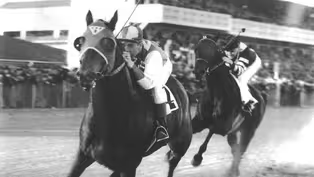
Preview: S15 Ep11 | 30s | Airs Monday, September 26, 2011 at 10:00 p.m. ET/PT. Check your local listings. (30s)
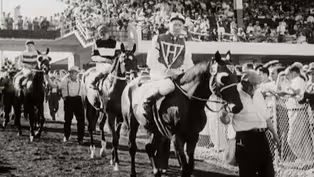
Preview: S15 Ep11 | 30s | An over-worked horse and a broken-down jockey capture the nation's imagination. (30s)
Providing Support for PBS.org
Learn Moreabout PBS online sponsorship














Support for PBS provided by:
Corporate sponsorship for American Experience is provided by Liberty Mutual Insurance and Carlisle Companies. Major funding by the Alfred P. Sloan Foundation.