
Illinois Could Join Voucher Program to Fund Scholarships for Private Schools
Clip: 2/3/2026 | 11m 8sVideo has Closed Captions
Gov. JB Pritzker is weighing whether to opt in to the federal program.
Under the federal program, donors can give up to $1,700 to nonprofits awarding K-12 scholarships and get an equivalent back in federal tax credits.
Problems playing video? | Closed Captioning Feedback
Problems playing video? | Closed Captioning Feedback
Chicago Tonight is a local public television program presented by WTTW
WTTW video streaming support provided by members and sponsors.
Illinois Could Join Voucher Program to Fund Scholarships for Private Schools
Clip: 2/3/2026 | 11m 8sVideo has Closed Captions
Under the federal program, donors can give up to $1,700 to nonprofits awarding K-12 scholarships and get an equivalent back in federal tax credits.
Problems playing video? | Closed Captioning Feedback
How to Watch Chicago Tonight
Chicago Tonight is available to stream on pbs.org and the free PBS App, available on iPhone, Apple TV, Android TV, Android smartphones, Amazon Fire TV, Amazon Fire Tablet, Roku, Samsung Smart TV, and Vizio.

WTTW News Explains
In this Emmy Award-winning series, WTTW News tackles your questions — big and small — about life in the Chicago area. Our video animations guide you through local government, city history, public utilities and everything in between.Providing Support for PBS.org
Learn Moreabout PBS online sponsorship>> Illinois is among several states deciding whether to opt into a new federal school voucher program under the program, which was passed by Congress in the so-called Big Beautiful Bill Act.
Donors can give up to $1700 to nonprofits warning K through 12 scholarships and receive an equivalent amount back in federal tax credits.
Scholarships can be used to help pay for private school tuition along with some out-of-pocket expenses for public school.
Families.
Like during or after school programming.
28 states have opted into the program so far most of which are Republican lead the 4 states that have said no to the program.
Are Wisconsin, New Mexico, Oregon and Hawaii and are all led by Democratic governors.
Governor JB Pritzker has yet to decide whether he'll opt the state in saying last week he was still waiting on program rules from the federal government.
>> Just on its face, the question is, is just just just a repeat of trying to take money out of public schools and moving into private schools, which is what the Trump administration generally speaking has been in favor of or is this something that could be useful?
But we just don't know because there are no rules around it right now.
>> Joining us to talk about this are and quarter education issues specialist for the League of Women, Voters of Illinois and Austin Berg, executive director for the Chicago Policy Center at the Illinois Policy Institute.
Thanks to both of you for joining us to talk about this and quarter your organization.
You all are among that coalition of groups that signed a letter to Governor Pritzker urging him not to opt into this program.
What are your main concerns?
40 organizations have joined us.
We would like Governor Pritzker to stand up for public education, which is the backbone of our democracy.
>> We think this should not be a partisan issue.
Public schools are most important thing that helps our workforce and provide social fabric and especially in rural communities.
We are also working to educate citizens an opportunity to vote in non-binding referendum on March.
17th, about 10% of the population will be able to do that.
Our concerns are that there is no such thing as free money that this program will harm public education in Illinois for a variety of reasons.
We think that this is not designed to help low-income students.
We believe that this is wide open for waste, fraud and abuse.
And so we urge the governor to opt out.
>> Austin, you and your organization, you're in support of this federal program.
How come the states and students in the state benefit from it?
Well, this unlocks hundreds of millions of dollars for education in Illinois.
>> hundreds of millions of dollars that would otherwise go to D C or other states.
So that's why you see Governor Jared Polis, Democratic governor in Colorado say we would be crazy not to opt in.
I grew up in Illinois and remember seeing, you know, booster clubs right at the football game, selling snacks are doing bake sales to fund scholarships for after-school programs.
Imagine if every single one of those clubs in across Illinois could take a one for one dollar federal tax credit that unlocks tens of millions of dollars for public schools in Illinois.
And that's why I think you see 28 states going for that how the I mean?
I know we've got some some stuff to work out.
But is that how the program works?
Right?
Like, for example, if I donate to one of the scholarship >> providing organizations I can receive up to that amount back in a federal tax credit.
but then that is, is that necessarily unlocking millions of dollars?
Does that money has to come reporters?
Asians?
>> No, it it's imagine I could either send $1700 to Washington, D.C., or I could send that $1700 to my local school community.
And that could be public school private school after school tutoring any education expense.
So I really do think it's a rising tide lifts all boats.
And I agree with what was said before.
I don't think it should be a partisan issue.
That's why you see red blue purple states opting in.
>> there are comparisons being made to the invest in Kids scholarship program that was in Illinois at sunset a couple of years ago.
When we learn from that program heavy think it applies here.
It's a very comparable program.
The tax credits are even more generous in this program.
It's 100% tax credit.
So there is absolutely no skin in the game by the donor.
>> It's 100% federal money coming out of our pockets as taxpayers.
2 private religious schools invest in kids should saw that most of the money went to more well off families that went to private religious schools and I the were often not able to enter the school that they chose this schools who are part of that program, 50% did not have any students of color who are black and 30% did not have Latino students.
Only 15% of those schools provided special education.
So to have that much federal money coming back into the states who have system that is private and religious and is not going to provide civil rights and special education opportunities for students we think is a big mistake.
In this the federal government says that the money is not necessarily just for private schools and institutions.
Public school students could also use it for programming or >> other sort of assistance provided that they need the income qualifications.
The rules have yet to promulgated the law itself mention some possibility of some.
>> Tutoring services being provided for public school students.
But it been very clear from the Department Education that no money should go to supplement to to make the school budget any any less tight?
It provide possibility that students will not access to.
Things that they would get in a public school.
Special education rights need to be weighed.
They need to have their funding >> for >> And which language learners would not be available in private schools.
But the public's aspect of it we think is highly unlikely to really provide much of a boon for public schools because if you look at what the administration has done with public education in the last year, the President Trump proposed cutting 300 million dollars from the education money flowing into the state he has provided already cut a number grants.
>> So but also want you back in here because there are those who argue that, you know, they use of scholarship programs like this, that this takes money.
It funnels it towards private schools and that if students from public schools or leave in public schools to go to private schools and that takes money from those public schools.
Would you say to that argument?
But I think it's misinformation to pit this as public versus private.
This is about more resources for education.
Whatever works best for the kid.
So for some kids, it's going to be some forms of private education.
>> Other kids they might need summer school after school assistance.
That's why the Democratic governor of Colorado opted and he said would be crazy not to provide, you know, after school programs or summer school or extracurriculars either that money is going to the federal government or it's staying here coming back here to Colorado.
And that's what I really think the option is here do you want you're $1700 going to DC where would you like it to fund or local school community?
And I think people from all political stripes would prefer that money went to our local school communities.
>> There's you know, there's also some supporters make the argument that, you know, opting out of the program essentially leaves money on the table.
That could be supporting students.
How do you respond to that?
And believe that the money that goes to Washington should be coming back to Illinois to public schools should be providing after school programming and tutoring program in and fully funding the special education.
We think that if we accepted this money, it would not outweigh the the harm that would be caused by the private public voucher program.
It will divert billions of dollars away.
As as Alison mentioned, it will be a huge program.
It will divert that money away from the title.
One programs in the special Ed programs that that could be coming to our state.
It will divert because it there's no free money.
There's no such thing as a free lunch.
It comes from somewhere.
Every time I these things, your head.
So I mean, come back to haunt So says taking your questions.
Do we want to fund scholarships and other states with their federal tax money or do we want that money coming back to Illinois?
This is our money.
It's not DC's money and we shouldn't have to rely on the Trump administration to give it to us.
And that's where I think.
>> The more you oppose what the Trump administration is doing right now, the more you should support this program, your money is not going to the Trump agenda in DC it's going to your local school community.
>> And I think like all political stripes should be on board with this.
And that's why you're seeing again, Democrat state's Republican states.
I think it.
>> And the federal government, as we've said, they're still developing the specific regulations.
What are your concerns about the details that we don't know about yet?
>> For example, I think I agree that it's not partisan, but I think that it should nonpartisan the other direction.
I think that no one should should be supporting this program.
It's wide open for fraud and abuse.
You've got a 10% gets to be diverted to the scholarship granting organization from that money that is collected.
10 1% goes to an intermediary organization.
It's not an efficient use of funding.
also not designed to really help low-income students or students really at all.
Research shows that voucher programs do not result in higher student achievement, particularly for low-income students, wrist that barely caught cover entire cost attending private religious schools, even with a Boucher, there's transportation costs, tuition these books.
It's too expensive for most low-income families.
>> Before we let you go, just got a little bit of time left Austin, you know, the case for school choice.
It has always been there seems to be getting a boost from the Trump administration.
Why might some families choose not to send their kids to public schools?
Well, its not one size fits.
All right.
Not everybody wears the same size shoes.
So some kids need different kinds of services.
Maybe they live closer to a private school that their families comfortable with or maybe they have a program that they would be able to access elsewhere.
>> And I think it's really important and it is really a civil rights choice.
We saw Milwaukee generations ago lead the civil rights movement for school choice with Dr Howard Fuller, just, you know, a few miles away from where we are now.
And I think it remains a civil rights issue that every parent should be able to choose the education that's right for their child.
And I think this definitely supports that, but also supports public schools.
Okay.
That is where we'll have to leave it.
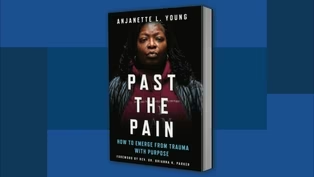
In New Book, Anjanette Young Shares Her Experience in Botched CPD Raid
Video has Closed Captions
Clip: 2/3/2026 | 9m 4s | A botched February 2019 raid left Anjanette Young handcuffed while naked inside her home. (9m 4s)
Providing Support for PBS.org
Learn Moreabout PBS online sponsorship
- News and Public Affairs

Top journalists deliver compelling original analysis of the hour's headlines.

- News and Public Affairs

FRONTLINE is investigative journalism that questions, explains and changes our world.












Support for PBS provided by:
Chicago Tonight is a local public television program presented by WTTW
WTTW video streaming support provided by members and sponsors.